AI prospecting, AI lead scoring, AI sales agents, automated outbound, and AI-powered account prioritization are becoming normal parts of B2B go-to-market.
But there is a less glamorous problem underneath all of them:
What happens when the CRM data feeding the AI is wrong?
Firmable's September 2026 research says B2B sales professionals estimate 32% of their CRM contact and account data is inaccurate, incomplete, or outdated. In the same research, 75% said they would choose perfect prospect data over the best AI sales assistant available.
A separate Firmable study found only 14% of respondents believed an AI agent could safely act on their existing sales data without cleanup first.
Those figures come from a B2B data vendor, so they should be treated as vendor research rather than universal market benchmarks. But the operating problem is straightforward: AI systems can only reason over the context they receive.
If the CRM is unreliable, automation can make unreliable decisions faster.
Direct answer: Why does clean CRM data matter for AI?
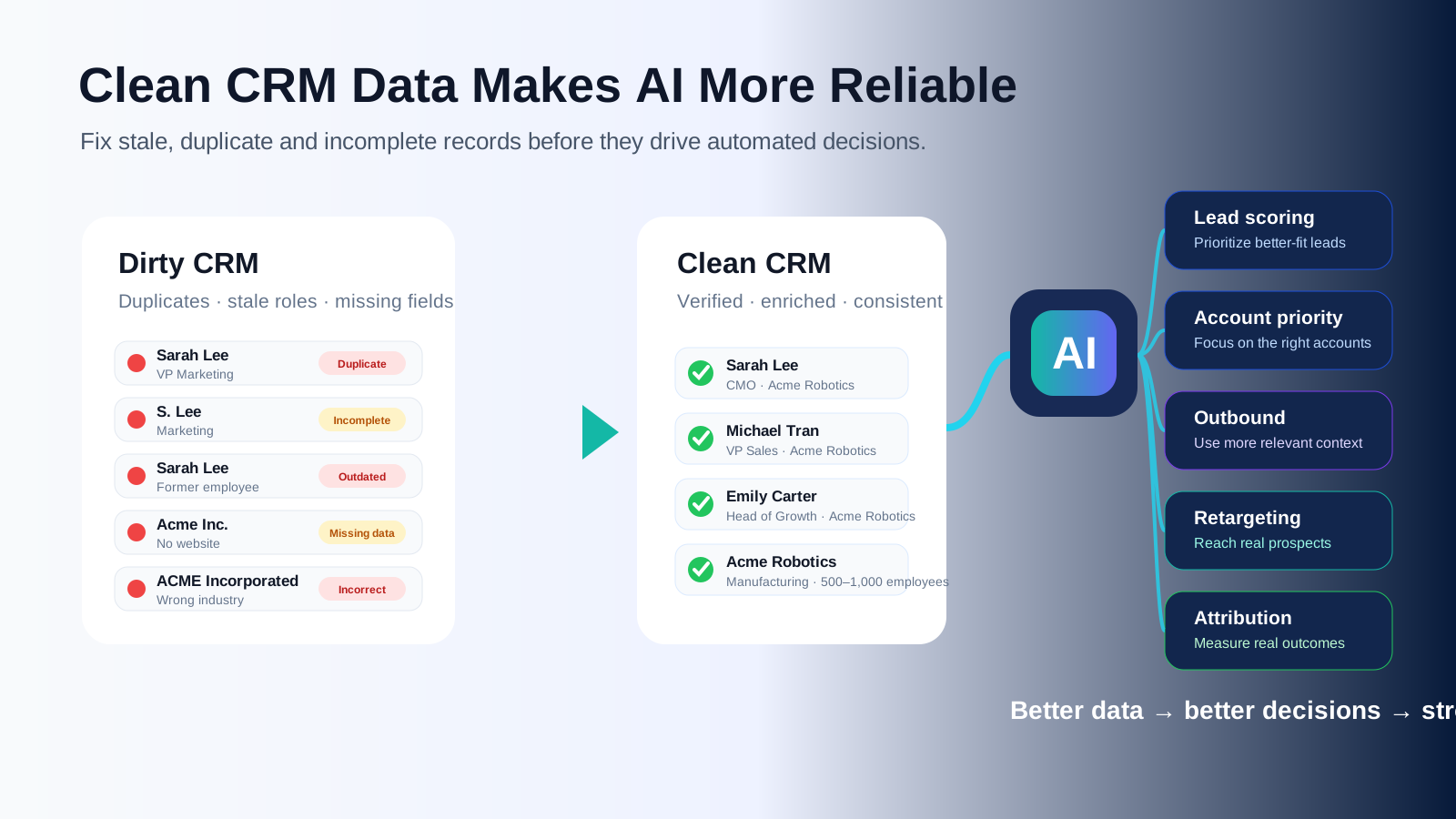
Clean CRM data matters because AI sales and marketing systems use CRM records to decide who to prioritize, what message to send, which audience to build, which opportunity to update, and how performance should be attributed.
If company names, job titles, lifecycle stages, opportunity statuses, lead sources, or ICP fields are wrong, an AI system can make a logically consistent decision using incorrect context.
That can affect:
- lead scoring
- account prioritization
- outbound research
- automated outreach
- retargeting audiences
- Google Customer Match
- LinkedIn Matched Audiences
- Meta custom audiences
- attribution
- routing
- forecasting
- signal-based selling
This makes CRM data quality an AI-readiness issue, not just an administrative cleanup task.
The CRM data problem in 2026
Firmable's current research into high-growth sales teams reports that respondents estimate 32% of CRM contact and account information may be inaccurate, incomplete, or outdated.
The same research found 75% would choose perfect prospect data over the best AI sales assistant.
Firmable's separate Agent-Ready Revenue Team research adds more context:
- only 14% said an AI agent could safely act on their sales data as-is
- 80% said they lose at least 10% of selling time finding, cleaning, or updating data
- 58% had discovered bad sales data only after contacting a prospect
- only 16% would let an AI agent take sales action without reviewing the information first
Source: Firmable, The Agent-Ready Revenue Team and Firmable's 2026 sales research.
The important question is not whether every company has exactly the same error rate.
The more useful question is:
How much of your decision-critical CRM data would change an AI-driven action if it were wrong?
CRM data decays even when nobody makes a mistake
A CRM does not need to be poorly managed to become inaccurate.
People change jobs.
Executives move companies.
Companies merge.
Roles change.
Email addresses become invalid.
Buying committees change.
Account ownership changes.
Opportunities stall or close without being updated.
Cognism's April 2026 analysis of C-suite data in the UK, France, and Germany estimated annual CRM data decay of:
- 35% for CMOs
- 34% for CROs
- 32% for CFOs
- 26% for CEOs
Cognism estimated that about half of C-suite CRM data could become inaccurate in less than two years in those markets. Its U.S. figures were somewhat lower, but the same pattern remained.
Source: Cognism, Half of C-suite CRM data out of date in less than two years.
Cognism is also a B2B data provider, so this is vendor research. Still, it illustrates why CRM hygiene must be continuous rather than a once-a-year cleanup project.
Bad CRM data can make good AI reasoning produce a bad result
One of the easiest AI risks to understand is hallucination.
But CRM-driven AI introduces another type of failure:
the AI can reason correctly using inaccurate data.
Imagine this record:
Contact: Sarah Lee
Company: Acme Robotics
Role: VP Marketing
Opportunity stage: Evaluation
Last activity: 12 days ago
An AI system might reasonably conclude:
Sarah is a senior marketing decision-maker at an active opportunity. Recommend a comparison case study and prioritize follow-up.
But what if Sarah left Acme Robotics four months ago?
The reasoning is not necessarily the problem.
The context is.
This distinction matters:
Bad reasoning: the AI misunderstood accurate information.
Bad context: the AI processed incorrect CRM information correctly.
A better model does not automatically solve the second problem.
Better data does.
Dirty CRM data affects paid media too
CRM data quality is often treated as a RevOps or sales operations problem.
It increasingly affects marketing performance directly.
Google Ads
Customer Match and offline conversion imports depend on reliable first-party data.
If lifecycle or opportunity information is wrong, Google can receive weak conversion-quality signals.
LinkedIn Ads
Matched Audiences can become less useful if contacts have changed companies, roles, or buying status.
Meta
Custom audiences and conversion feedback can include stale contacts or poorly classified leads.
Retargeting
A company may continue advertising to:
- closed-lost accounts that should be suppressed
- existing customers receiving acquisition ads
- former employees
- low-fit leads
- contacts whose role no longer matches the buying group
The problem is not just wasted impressions.
Bad CRM information can teach automated ad systems that the wrong users are valuable.
Dirty CRM data weakens signal-based outbound
Modern outbound increasingly combines:
ICP fit + behavioral signal + timing + account context
That is much stronger than sending a cold sequence because someone appears on a static prospect list.
But signals only become useful when identity is reliable.
Imagine this workflow:
calculator completion → company identified → account enriched → account scored → salesperson alerted
If the company domain is attached to the wrong account or the contact has changed roles, the same workflow can create a false priority.
This is why I would prioritize first-party behavioral signals plus verified CRM records over collecting as many third-party signals as possible.
For a deeper look at this model, see Cold Outreach Strategy for 2026: How Signal-Based Outreach and Automation Work Together.
What CRM data should you clean first?
You do not need every CRM field to be perfect.
Start with fields that affect real decisions.
1. Contact identity
Check:
- full name
- current company
- current role
- business email
- phone where relevant
- LinkedIn profile
- contact status
2. Company identity
Check:
- company name
- company domain
- industry
- employee range
- location
- account owner
- parent or subsidiary relationship where relevant
3. Lifecycle and opportunity data
Check:
- lead status
- lifecycle stage
- opportunity stage
- open/won/lost status
- customer status
- last meaningful engagement
- next action
4. Attribution fields
Check:
- original source
- campaign
- medium
- referral source
- self-reported source
- first-touch and latest-touch data where used
5. ICP fields
These are the fields your company actually uses to decide fit.
They might include:
- employee count
- industry
- geography
- technology stack
- service area
- event date
- guest count
- budget
- buying role
- business model
If an AI scoring model uses a field, that field should be treated as decision-critical.
A simple 100-record CRM data-quality audit
Before adding another AI GTM tool, audit a small sample.
Take 100 recent CRM records.
For every record, verify the fields that affect routing, scoring, advertising, outreach, or forecasting.
Classify each decision-critical field as:
- Accurate
- Incorrect
- Missing
- Outdated
- Duplicate or conflicting
Then calculate:
CRM record error rate = records with at least one decision-critical error ÷ records audited × 100
This is deliberately simple.
The goal is not to measure cosmetic cleanliness.
The goal is to measure how often the CRM could cause a different business decision.
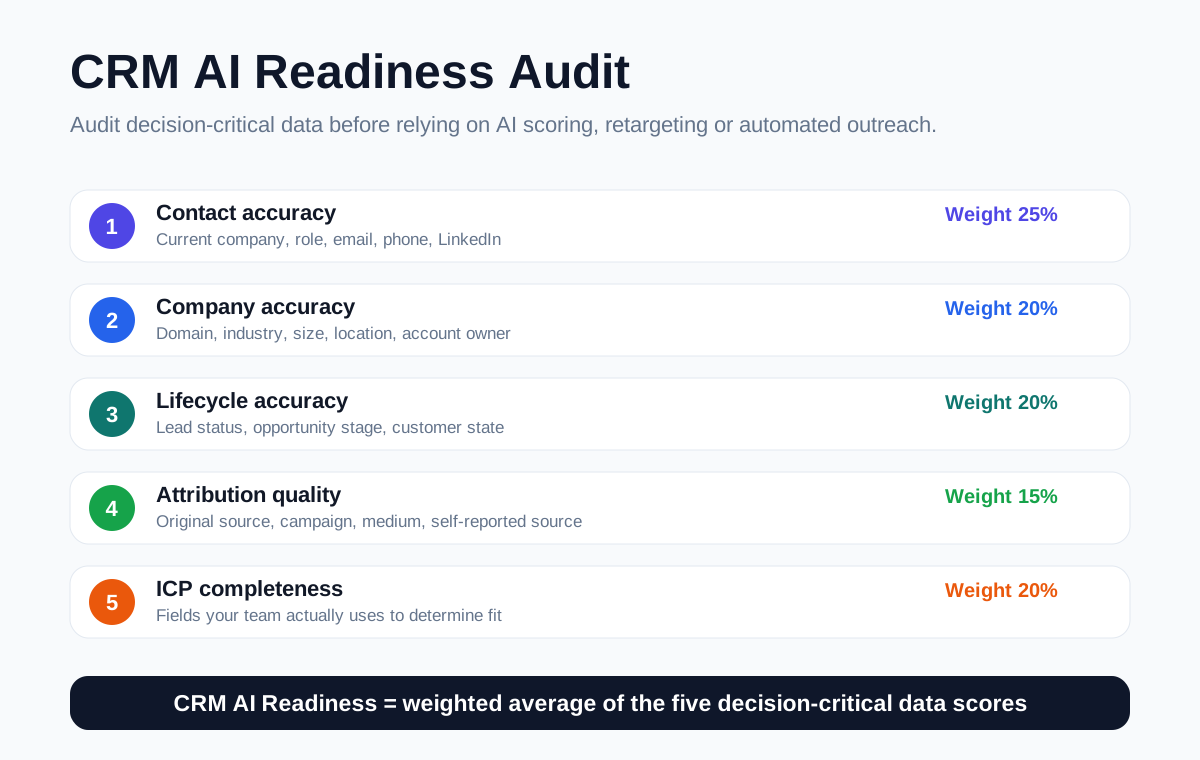
Build a CRM AI Readiness Score
A useful internal diagnostic can weight the five areas differently.
| CRM data area |
Suggested weight |
| Contact accuracy |
25% |
| Company accuracy |
20% |
| Lifecycle accuracy |
20% |
| Attribution quality |
15% |
| ICP-field completeness |
20% |
Score each area from 0 to 100.
Then calculate the weighted average.
CRM AI Readiness Score = weighted average of decision-critical data quality
This is not an industry standard.
It is a practical framework for deciding which data problems should be fixed before increasing automation.
Test the AI before and after CRM cleanup
Here is a more interesting experiment than asking an AI agent to write another sales email.
Take the same set of accounts and run the same AI workflow twice.
Test 1: Current CRM data
Ask the system to:
- rank target accounts
- score fit
- identify likely decision-makers
- recommend the next action
- suggest a message angle
- choose a relevant case study or resource
Save the output.
Clean the decision-critical data
Correct stale roles, company information, lifecycle stages, duplicate records, attribution fields, and missing ICP data.
Test 2: Clean CRM data
Run exactly the same instructions again.
Then measure:
- how many account rankings changed
- how many recommended contacts changed
- how many next actions changed
- how many previously high-priority accounts fell
- how many ignored accounts rose
- how often the original recommendation would have targeted the wrong person
- how often the recommended message changed
This produces an AI-readiness benchmark based on actual decision changes, not an abstract data-quality score.
Clean data does not mean collecting more fields
A common response to poor data quality is buying more data.
That can make the CRM worse.
A system with 150 incomplete, stale, or contradictory attributes is not automatically more useful than a CRM with 20 dependable fields.
Ask:
What information must be correct for this workflow to make a good decision?
For lead prioritization, that might be:
company + current role + industry + size + location + lifecycle + opportunity status + recent engagement
Start there.
CRM cleanup should be continuous
Data quality declines continuously, so the cleanup system should also be continuous.
A practical workflow can look like:
new contact enters CRM
→ normalize company/domain
→ duplicate check
→ verify contact identity
→ enrich decision-critical fields
→ validate ICP fit
→ assign lifecycle stage
→ monitor important changes
Then add behavior:
research page visit
→ calculator or diagnostic usage
→ pricing-page engagement
→ repeat commercial visit
→ account signal
Now AI has better context for analysis, prioritization, and workflow decisions.
If you are designing automated routing, this small-agency lead routing workflow shows how to think about qualification and routing as a system rather than a pile of disconnected automations.
What should you automate first?
Clean data makes more automation possible, but the strongest place to begin is usually with low-risk operational tasks.
Good early candidates include:
- duplicate detection
- missing-field detection
- stale-contact detection
- enrichment
- account summaries
- field normalization
- lifecycle inconsistency alerts
- lead routing checks
- reporting QA
Higher-impact actions need stronger controls, clearer business rules, and higher-confidence data.
Examples include:
- sending outbound messages
- changing opportunity stages
- changing ownership
- suppressing or activating ad audiences
- changing forecasts
- modifying customer records
The principle is simple:
automation should become more autonomous only when the underlying data and workflow have demonstrated reliability.
Clean CRM data also helps SEO, AEO, and GEO indirectly
CRM data quality sounds unrelated to search.
It is not.
Your CRM contains buyer language, objections, industries, use cases, lead sources, and commercial questions.
When that information is reliable, it can improve:
- FAQ research
- comparison content
- buyer-question mapping
- case-study segmentation
- industry landing pages
- ROI calculator assumptions
- AI-search prompt testing
- thought-leadership topics
A clean CRM can reveal what real buyers ask before purchasing.
That information can then strengthen both SEO content and AI-answer visibility.
This is especially useful when building decision-support assets rather than generic informational content.
For more on that strategy, see Do Interactive Tools Get More AI Referral Traffic Than Blog Posts?.
Frequently asked questions
What is clean CRM data?
Clean CRM data is contact, company, lifecycle, attribution, and opportunity information that is accurate, current, consistent, complete enough for the business process using it, and free of important duplicates or contradictions.
Why is CRM data quality important for AI sales agents?
AI sales agents use CRM records as context for scoring, prioritization, research, routing, messaging, and workflow decisions. Incorrect CRM fields can therefore lead to incorrect automated actions even when the AI's reasoning itself is sound.
How often should CRM data be cleaned?
CRM data should be monitored continuously. Job changes, company changes, invalid contact details, opportunity updates, and duplicate records can make a clean database stale over time.
What CRM fields should be cleaned first?
Prioritize fields that affect business decisions: current company, current role, contactability, company domain, ICP fit, lifecycle stage, opportunity stage, customer status, attribution, and recent engagement.
Can AI clean CRM data?
AI can help identify duplicates, inconsistent values, missing fields, stale records, and enrichment opportunities. Verification sources, deterministic rules, and reliable enrichment data still matter because an AI system cannot independently guarantee that every inferred field is correct.
Is CRM cleanup part of AI readiness?
Yes. If an AI workflow depends on CRM information for a decision or action, CRM data quality is part of the system's AI readiness.
Does cleaner CRM data improve retargeting?
It can. Reliable lifecycle, customer, account, and contact data can help marketers suppress irrelevant audiences, build more meaningful high-intent segments, and feed stronger downstream conversion information into advertising systems.
The real AI advantage may start with boring infrastructure
The B2B AI market is moving quickly.
New agents can research accounts, score prospects, build audiences, recommend messages, analyze campaigns, and trigger workflows.
But every one of those systems needs context.
That makes CRM quality increasingly strategic.
The strongest AI GTM stack may not be the company with the largest collection of agents.
It may be the company whose systems have:
- dependable account identity
- current contacts
- consistent lifecycle definitions
- trustworthy opportunity stages
- usable attribution
- verified ICP fields
- meaningful behavioral signals
Then AI can reason over something worth trusting.
Before asking:
Which AI sales agent should we add next?
Ask:
How often would our current CRM data cause that agent to make a different decision?
That is a much better starting point for building an AI-ready revenue system.
Sources
Research note published September 27, 2026. Firmable and Cognism both sell B2B data products, so their statistics are presented as vendor research and should not be interpreted as universal benchmarks.