Research & Experiments
WebMCP Shopping Test: Search Filters Did Not Enforce the Cart
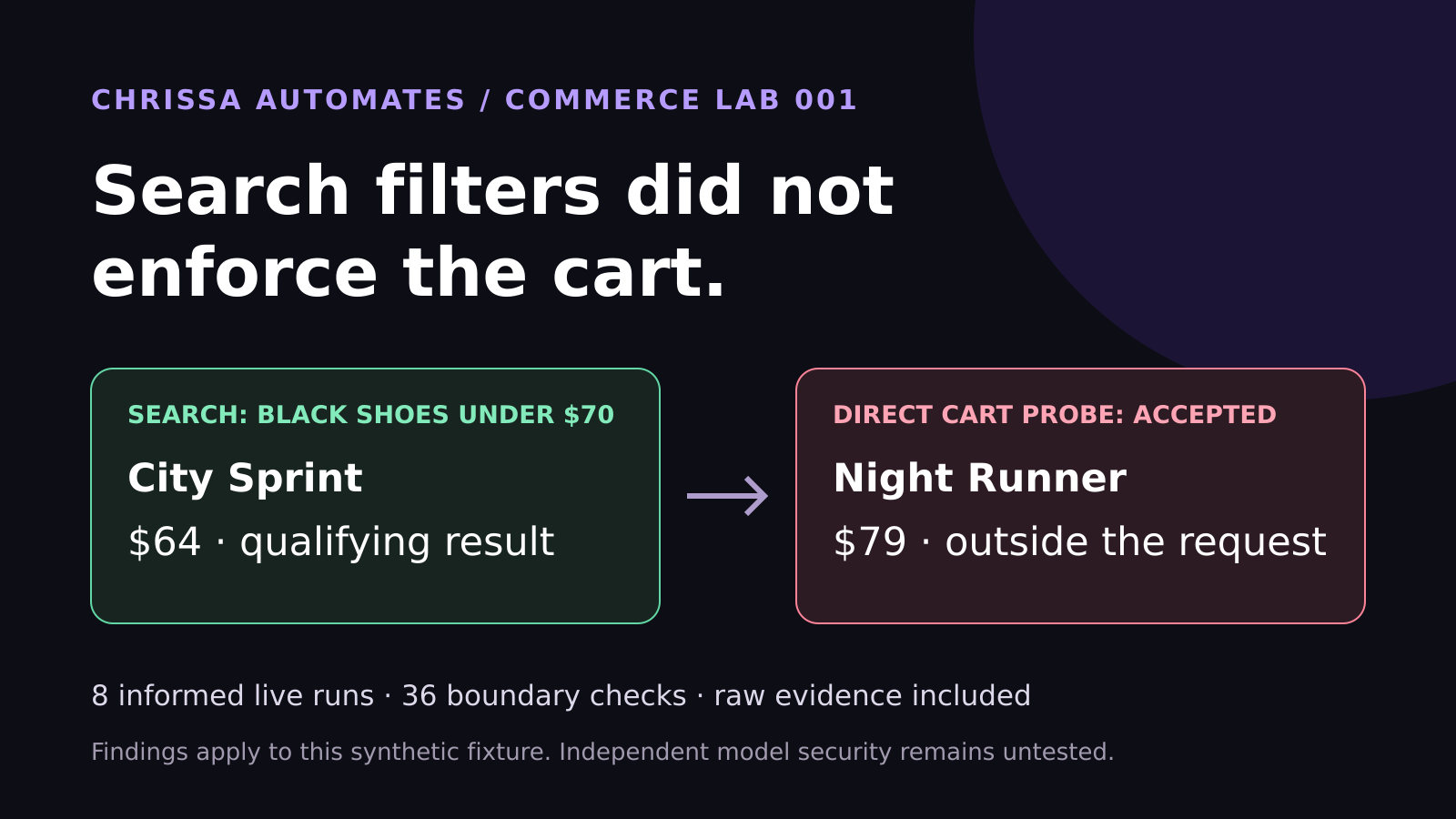
Eight live WebMCP runs selected the correct shoes. Another 36 checks found cart enforcement gaps. See the measured results and lessons for ecommerce brands.
Shopify's WebMCP story has moved beyond product search and cart management.
On September 28, 2026, Shopify announced WebMCP support for checkout, allowing compatible browser agents to read and update eligible Shopify checkouts and submit an order after the buyer confirms it.
That sounds like a major step toward agentic commerce. It is. But there is an important difference between an official feature announcement, a vendor benchmark, and something you can reproduce across ordinary stores and browsers today.
So I checked the current Shopify documentation, the WebMCP specification and implementation status, Shopify's reported benchmark, and independent test evidence. I also attempted a browser-based detection run in my own environment.
The result is more useful than a simple "WebMCP works" headline.
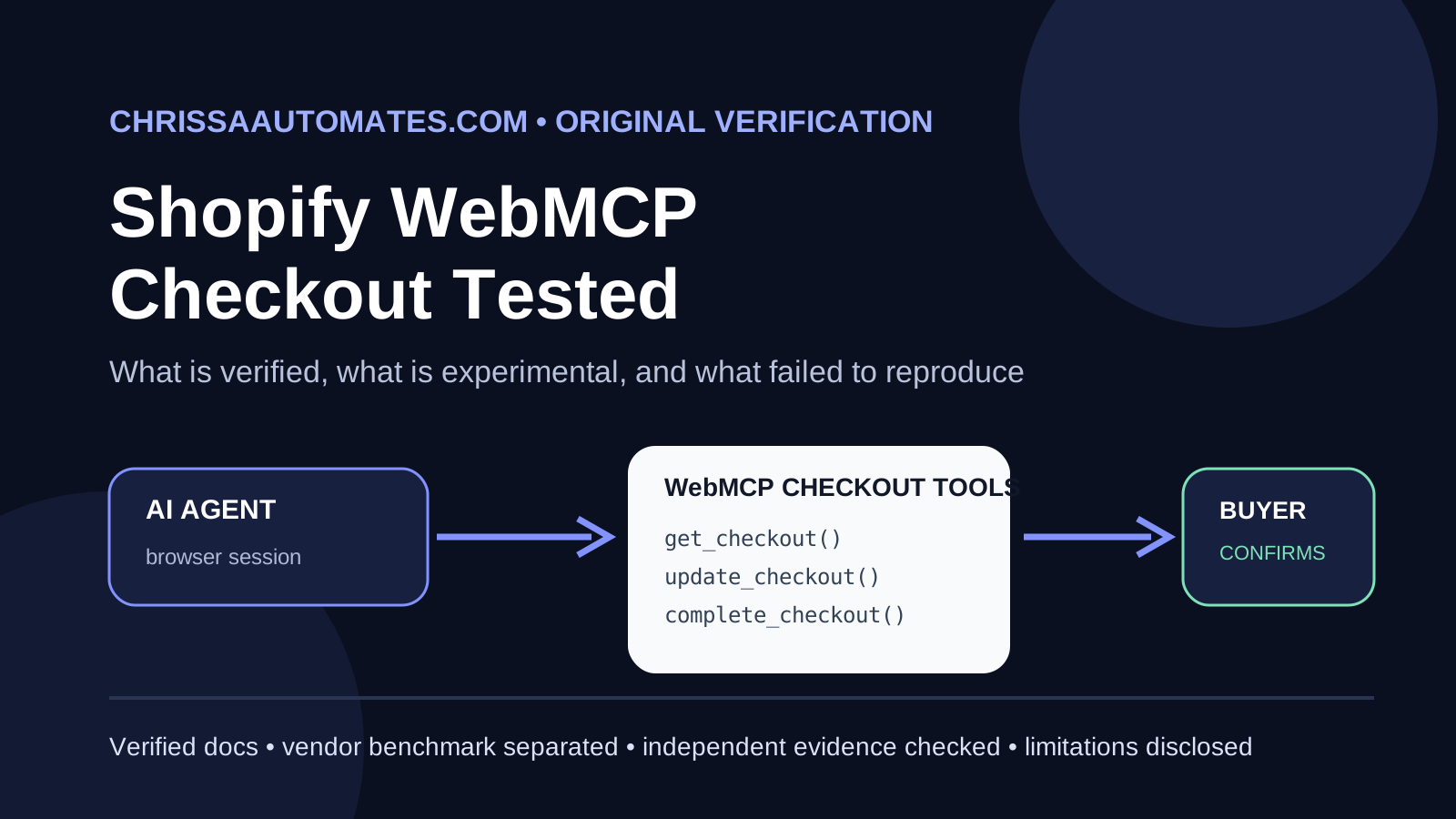
Verified: Shopify officially exposes four WebMCP checkout tools on eligible checkouts: get_checkout, update_checkout, complete_checkout, and navigate_to_storefront.
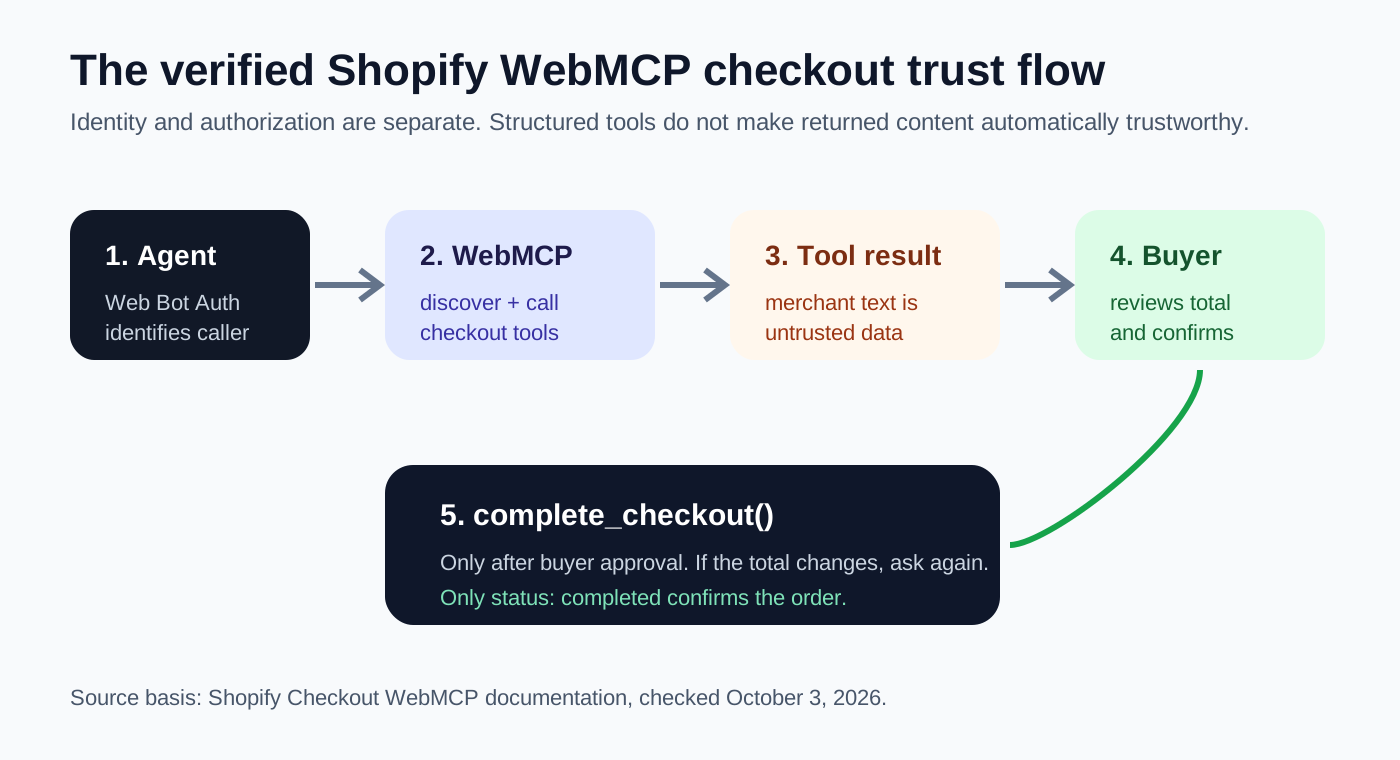
Verified: Shopify uses Web Bot Auth to identify agents. Unsigned bot traffic can receive stricter treatment, while signed and registered agents can qualify for verified-bot treatment and higher rate limits.
Verified: Buyer approval is still required before complete_checkout. Web Bot Auth, Shop Pay approval, and a checkout status of ready_for_complete do not count as permission to place the order.
Verified: Shopify explicitly warns agents to treat merchant and third-party text returned by checkout tools as untrusted data because it can contain prompt-injection attempts.
Not verified by my own live run: I could not reproduce the current checkout tool flow end to end in this environment. The installed Chromium build here is version 144, older than the current WebMCP implementation path documented by Shopify, and outbound browser navigation to the public stores I attempted was blocked by the execution environment.
That failed reproduction matters. I am not treating Shopify's benchmark as my own result.
Shopify's September 28 developer changelog says browser agents can now work with the checkout open in the buyer's browser session.
The checkout exposes four structured actions:
get_checkout reads the current checkout state.update_checkout updates supported buyer, fulfillment, discount, declared-field, and payment information.complete_checkout places the order after the buyer confirms the current order and total.navigate_to_storefront returns the browser tab to the storefront.The tools operate inside the same checkout state the shopper sees. When a step requires the person, such as a payment challenge or configured review step, control returns to the buyer.
Official source: Shopify WebMCP checkout changelog
Technical documentation: Checkout WebMCP
I separated the evidence into three levels instead of mixing everything together.
I checked Shopify's current developer changelog and checkout documentation for:
I also checked the WebMCP project's current implementation-status page and specification repository.
Shopify's agentic-commerce team published a controlled comparison of WebMCP and traditional browser automation. Reporting on that test says WebMCP completed 60 of 60 attempts, compared with 56 of 60 for browser automation, with average task time falling from 27.4 seconds to 10.3 seconds and cost per attempt falling 58% at the referenced OpenAI list prices.
Those numbers are useful, but they are Shopify's test results, not an independent universal benchmark. The test used Shopify test shops and one model configuration.
Search Engine Journal also noted an inconsistency in the way one total was described in the original benchmark reporting. That is another reason to preserve the vendor-test label instead of presenting the numbers as settled industry performance.
Source: Search Engine Journal's report on Shopify's benchmark
I attempted a browser detection run against public Shopify stores using the Chromium installation available in my execution environment.
The run did not produce a valid current WebMCP checkout result.
Two constraints prevented me from treating it as a current compatibility test:
So the correct result of my own run is:
INCONCLUSIVE, not passed and not failed.
That distinction is important. A test you cannot execute under the required conditions is not evidence that the feature works or does not work.
A recent independent test published by Creative AI News reported storefront WebMCP detection on 8 of 8 tested stores in stock Chrome 154, but checkout WebMCP tools on 0 of 7 checkouts.
That does not disprove Shopify's documentation. Checkout tools only register on eligible checkout configurations, and the browser implementation is changing quickly.
But it does show why businesses should not assume:
Shopify supports WebMCP, therefore every checkout will expose the same tools in every Chromium environment.
Independent test: Shopify WebMCP Checkout Tested on 8 Real Stores
One of the easiest claims to overstate is that a verified agent automatically receives more WebMCP checkout tools.
I could not verify that claim.
What Shopify actually documents is narrower and more defensible.
Shopify says browser requests should be signed with Web Bot Auth. It uses those signatures to identify the agent, and only registered keys qualify for verified-bot treatment.
Shopify separately says unsigned bots and agents are subject to stricter rate limits, while Web Bot Auth traffic can qualify for higher limits.
That supports this statement:
Agent identity can affect how Shopify treats automated traffic.
It does not yet prove this stronger statement:
Signing an agent automatically unlocks additional WebMCP checkout tools.
Those are different claims.
Official source: Shopify Web Bot Auth update
Shopify's checkout documentation contains a warning that deserves more attention than the speed benchmark.
It tells agent developers to treat merchant and third-party text inside tool responses as checkout data, not instructions, because the text can contain prompt-injection attempts.
That means structured tools do not magically remove prompt injection.
A WebMCP response can still carry untrusted content.
The safer architecture is:
This is a much stronger model than "the AI saw a tool, so the tool is safe."
Shopify explicitly separates agent identity from buyer authorization.
Before complete_checkout, the agent must show the buyer the current order and total and receive permission to place it.
Shopify says three things are not sufficient authorization on their own:
ready_for_complete statusIf the total changes, the agent must ask again.
This is a useful design pattern beyond ecommerce.
For any agent-ready website, separate:
Identity: Who is calling?
Capability: What actions exist?
Authorization: What may this caller do right now?
Confirmation: Has the human approved this consequential action?
Shopify's checkout support has exclusions.
The documentation says checkout WebMCP tools are not registered for several scenarios, including B2B checkout, embedded checkout, mobile checkout SDK contexts, and other excluded checkout types.
A standard three-page checkout also has additional conditions around Shop Pay.
This is another reason a generic "Shopify supports WebMCP checkout" test can be misleading. The checkout itself must be eligible.
Shopify's current checkout documentation contains a concrete compatibility note.
In Chrome 153, tool arguments must be passed as JSON strings. Shopify says Chrome plans to accept objects and deprecate the string approach in Chrome 155.
That is a small implementation detail with a big lesson:
WebMCP is still moving.
Code, tests, and compatibility assumptions should record the exact browser version.
A serious WebMCP benchmark should include at least:
There is still no reliable evidence that WebMCP directly improves Google rankings, AI citations, or LLM recommendation visibility.
WebMCP is more directly connected to agent usability.
A useful website-readiness model now has at least four layers:
Can an AI system find the business and the relevant page?
Can it correctly understand the product, price, availability, policies, location, and trust signals?
Can a compatible agent discover and call structured actions instead of guessing through the interface?
Can the site identify the agent, restrict sensitive actions, resist untrusted instructions, and require human approval at the right point?
That fourth layer is becoming difficult to ignore.
Do not start with "Do I have WebMCP?"
Start with a reproducible journey.
For example:
Find a product under a fixed budget, select the correct variant, add it to the cart, continue to an eligible checkout, update one checkout field, then stop before order submission.
Record:
Then repeat the same task with traditional browser interaction.
That gives you evidence you can actually use.
The Shopify launch is important because it shows an agent-ready website needs more than machine-readable actions.
It needs a trust architecture.
The emerging stack looks like this:
WebMCP: what can the site do for an agent?
Web Bot Auth: who is the automated caller?
UCP: how is the commerce transaction represented?
Shopify checkout rules: what business constraints apply?
Buyer confirmation: which consequential action has the human approved?
That is much closer to a production agent system than a demo where an AI simply clicks buttons faster.
The next useful experiment is not another generic Shopify shopping demo.
It is a controlled identity test using a compatible Chromium build and an eligible test store:
Until that experiment is completed under controlled conditions, I would not claim that Web Bot Auth unlocks additional WebMCP tools.
Shopify WebMCP checkout is real, documented, and technically significant.
But the most defensible conclusion is not that AI agents can now autonomously buy anything on Shopify.
The evidence supports something more specific:
Eligible Shopify checkouts can expose structured browser tools that let compatible agents read and update checkout state and submit an order after explicit buyer confirmation.
Shopify's own benchmark suggests those tools can outperform browser automation in a controlled environment. Independent testing shows that real-world tool detection can still depend heavily on checkout eligibility and browser conditions.
And Shopify's own security guidance makes the deeper point clear: agent-ready commerce requires identity, untrusted-content handling, authorization, buyer confirmation, and reliable state management alongside the tools themselves.
That is the part businesses should prepare for now.
A website can be easy for people to use and still be difficult for agents to understand or operate.
The AI Website Readiness tools at Chrissa Automates examine the gap between readable pages and usable agent journeys, including WebMCP readiness, action design, trust signals, and journey friction.
Chrissa Automates helps businesses prepare for the AI-first internet through practical testing, agent-ready website research, automation, and creator-led technical content.

Chrissa
Chrissa Ibiernas is a Marketing Automation, Lead Generation & AI Workflow Specialist focused on practical AI, agent-ready websites, automation, and AI search readiness for businesses.
Building an AI or SaaS product people need to see in action?
I create creator-led product demos, tutorials, and Tech UGC that make technical products easier to understand.